
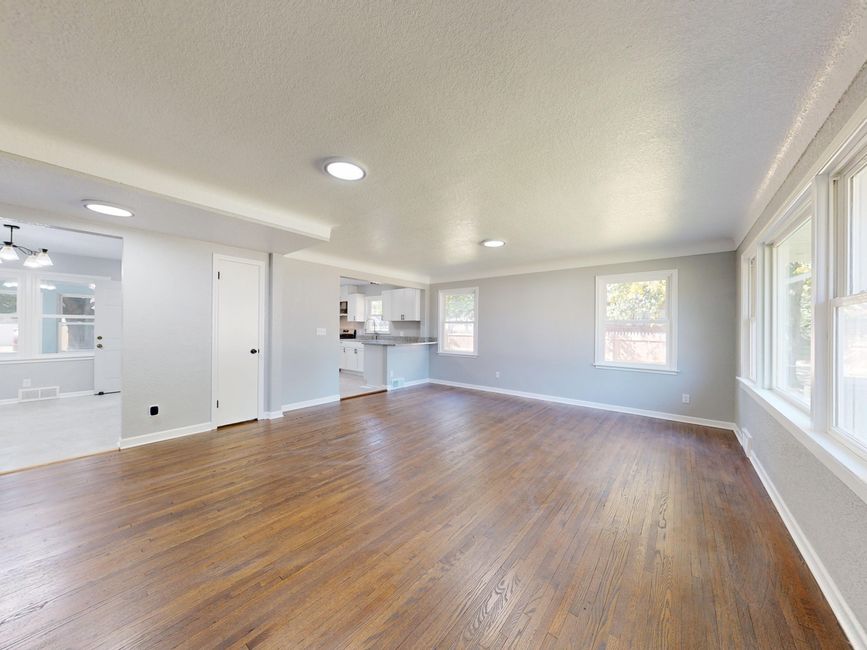
At an open house, say plainly that the furniture shown in the listing photos was added digitally, point visitors to the disclosure and provenance page, and confirm that the room itself should be evaluated in person. Avoid language suggesting that the depicted sofa, décor, spacing, or scale is part of the property.
At 11:20 on a Saturday morning, Maya, an invented composite of a listing agent, stood in an empty living room in Sacramento with a stack of feature sheets under one arm. A visitor held up the listing photo on his phone and looked at the bare wall.
“Where’s the sofa?”
Two other visitors stopped talking. Maya had used virtual staging to help people picture the room, but her first answer would shape what they understood about the furniture, the available space, and the accuracy of the listing. If she called the image a faithful representation, the visitor might leave believing the sofa had existed there or that its apparent dimensions proved what would fit.
Maya paused, opened the public disclosure page on her tablet, and used the script she had prepared.
A plain-language open-house script
“This room was virtually staged in the listing photo. The sofa and other furnishings were added digitally and are not included with the property. The image carries an AI-editing disclosure, and this page shows the source photo and the staged version. Please use the actual room and your own measurements when deciding what furniture may fit.”
That script handles four separate points without turning the conversation into a legal lecture:
- It identifies the image as virtually staged.
- It distinguishes the depicted furniture from the property being offered.
- It directs the visitor to the disclosure and source record.
- It avoids treating an AI-generated layout as proof of dimensions or clearance.
If the visitor asks whether a sectional will fit, the answer should stay equally direct: “The staged image is an illustration. Please rely on verified room measurements and check the clearance needed for your furniture.”
That wording matters. A generated sofa can look proportionate while having no reliable relationship to a real manufacturer’s dimensions. Its position may also conceal practical questions involving door swing, walkways, outlets, windows, or heating vents. Closet door clearance can become a listing-trust issue for the same reason: a polished image may suggest a use of space that the physical room does not support.
Keep the disclosure attached to the image
A verbal explanation at the open house helps, but it does not repair an undisclosed image that already traveled through an MLS feed, portal, social post, text message, or printed handout. Review the version visitors are likely to have seen before the doors open.
The disclosure should be visible on the image itself when applicable, using wording and placement appropriate to the relevant state and distribution channel. California AB 723 makes this especially concrete for covered digitally altered real estate images. Rules and association guidance vary, so agents should confirm current requirements with their broker, state association, MLS, or legal adviser.
NestPath Listing Studio adds a burned-in, per-state AI disclosure to virtually staged photos and creates a public provenance page connecting the original photo with the edited output. That record gives the agent something specific to show when a visitor asks what changed. It supports disclosure work; the agent still decides whether the wording, image use, and distribution comply with applicable rules.
Before printing feature sheets, verify that the disclosed file is the file being printed. Before scheduling social posts, verify the same thing again. A disclosure can disappear when someone exports a clean copy, crops an image, or selects the wrong version from a crowded downloads folder. The disclosure that may vanish when a staged photo travels explains why the distributed file deserves its own review.
Avoid promises about furniture and dimensions
The safest script describes what was changed and tells the visitor where to verify the physical facts. It does not defend the staging as “exact,” “to scale,” or “what the room will look like.”
Avoid statements such as:
- “That sofa fits perfectly in here.”
- “The image shows the actual room dimensions.”
- “Everything is shown to scale.”
- “You can fit this exact layout.”
- “Only the furniture changed,” unless you have reviewed the original and edited files closely enough to support that claim.
Use narrower language instead:
“The furniture is digitally depicted.”
“The room is currently vacant.”
“The original photo is available on the disclosure page.”
“Measurements should be independently verified.”
“The staged layout is one visual possibility, not a space plan.”
These lines may sound restrained. That is useful. The agent’s job at this moment is to prevent a visual aid from becoming an unsupported factual representation.
Prepare the answer before visitors arrive
By noon, another visitor asked Maya whether the staged coffee table left enough room to reach the patio door. This time, there was no pause.
“The table was added digitally, so its size and clearance are illustrative. Let’s look at the actual doorway, and you should verify the measurements for the furniture you plan to use.”
She then showed the visitor the original image beside the staged version. The conversation moved from an implied promise about an invented coffee table to the physical room in front of them.
Before your next open house, open every virtually staged image on the devices and materials visitors will encounter. Confirm that the disclosure is legible, keep the provenance page ready, and rehearse the script once. When someone asks where the sofa went, your answer should take seconds and leave no doubt about what was real.
Comments
No comments yet.